
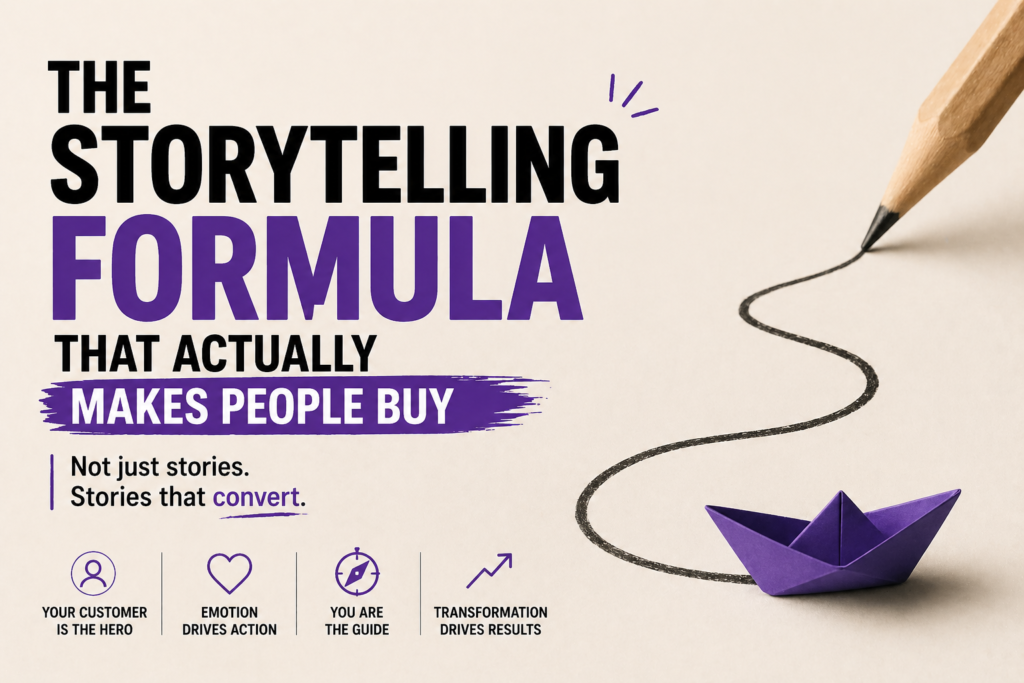
Everyone says “tell a story.” Nobody tells you how to tell one that makes someone reach for their wallet. Here’s the difference between a story that gets applause and one that actually converts.
Why Most Brand Stories Fall Flat
Open any brand’s “About” page and you’ll find the same story told a thousand different ways:
“We were frustrated with the existing options. So we built something better. Now we’re on a mission to change the industry.”
Technically, that is a story. It has a problem, a turning point, and a direction. But it doesn’t make you feel anything. And if it doesn’t make you feel anything, it doesn’t make you do anything.
The reason most brand storytelling fails isn’t because it’s bad writing. It’s because it’s about the wrong character.
The brand is not the hero of your story. Your customer is.
Once you understand that, everything changes.
The Real Storytelling Framework (Borrowed from Hollywood)
The best marketing storytellers don’t study copywriting. They study screenwriting. Because Hollywood has spent a century figuring out exactly how to make strangers care about made-up people in made-up situations — and the mechanics are completely transferable.
Here’s the framework, stripped down to what matters for marketing:
1. The Character (Your Customer, Not You)
Every great story starts with a character the audience can see themselves in. Not a demographic. Not a buyer persona with a stock photo and a fake name. A real human being with a specific problem, a specific fear, and a specific desire.
The more precisely you can describe this person, the more powerfully they will feel seen. Counterintuitively, specificity creates universality. A story about “a tired 34-year-old founder who keeps missing her daughter’s bedtime because of back-to-back Zoom calls” reaches more people than “a busy professional.”
The marketing move: Before you write a single word of copy, write one paragraph that describes your customer’s daily frustration in more detail than they’ve ever heard it described before. When someone reads it and thinks “how did they know?” — that’s your opening line.
2. The Conflict (Make It Real, Not Convenient)
Bad marketing glosses over conflict. Great storytelling leans into it.
Your customer is not just mildly inconvenienced. They’re losing sleep. They’re embarrassed. They feel stuck, behind, invisible, overwhelmed, misunderstood — pick one and dig into it. The deeper you’re willing to go into what’s actually wrong, the more trust you build, because most brands flinch before they get to the real pain.
This is what Donald Miller calls the “villain” in his StoryBrand framework — the external problem has an internal emotional cost, and that internal cost is what actually drives purchase decisions.
Nobody buys a gym membership because they are out of shape. They buy it because being out of shape makes them feel like they’ve lost control of themselves. The external problem is physical. The internal problem is identity. The best stories — and the best marketing — address both.
The marketing move: For every product benefit you list, ask “and what does that mean emotionally?” Keep asking until you hit something that feels vulnerable. That’s the real selling point.
3. The Guide (Your Brand’s Actual Role)
Here’s the shift that fixes most broken brand storytelling.
Think of the most beloved mentor figures in cinema. Yoda. Morpheus. Alfred. Gandalf. Notice what they all have in common: they are not the main character. They are wise, experienced, and capable — but their entire purpose is to help the hero succeed.
That is your brand’s role. Not the hero. The guide.
The guide shows up with three things: empathy (I understand your struggle), authority (I’ve helped others through it), and a plan (here’s the path forward). When your marketing communicates all three, it stops feeling like a pitch and starts feeling like a conversation with someone who genuinely gets it.
The marketing move: Audit your homepage. Count how many times you say “we” versus “you.” If “we” wins, rewrite it from the customer’s perspective. Every sentence should be about their journey, not your capabilities.
4. The Stakes (What Happens If They Don’t Act)
This is the most underused element in marketing storytelling.
Most brands focus entirely on the positive outcome — what life looks like after the purchase. But the most emotionally compelling stories show both paths: what happens if the hero succeeds, and what happens if they don’t.
This isn’t about being manipulative or fear-mongering. It’s about being honest. Your customer is weighing a real decision. Helping them see the cost of inaction — clearly and respectfully — is part of giving them the full picture.
Amazon does this constantly. So does every insurance company that’s ever run an ad. The best version of this isn’t scary, it’s clarifying: “Here’s where you could be six months from now if you take this step. And here’s where you might stay if you don’t.”
The marketing move: Write two paragraphs — one describing the customer’s life after they use your product, one describing their life if they keep doing what they’re doing. Use the contrast as the backbone of your email sequences, landing pages, and case studies.
5. The Transformation (Show the After, Not the Product)
The biggest mistake in product marketing is leading with the product.
Nobody wants your product. They want who they become because of it. They want the confidence, the relief, the status, the freedom, the belonging that comes on the other side of using it.
Apple doesn’t sell laptops. It sells the identity of a creative professional. Patagonia doesn’t sell jackets. It sells the identity of someone who gives a damn about the planet. Nike doesn’t sell shoes. It sells the belief that you have what it takes.
Your product is the bridge, not the destination. Show people where the bridge leads.
The marketing move: Find your most successful customer. Document not just what results they got, but how they feel now versus how they felt before. Use their words, not marketing language. That transformation story is worth more than any product description you’ll ever write.
The Structure That Converts
Put all five elements together and you get a story arc that works across every format — a 30-second ad, a landing page, an email sequence, a pitch deck:
- Open on a character in a specific, relatable struggle
- Deepen the conflict — name the external AND internal problem
- Introduce the guide — you, with empathy + authority
- Offer a plan — simple, clear, believable steps
- Show the stakes — the transformed life, and the cost of staying stuck
- Call to action — one clear next step
Simple? Yes. But most brands skip steps 2, 3, and 5 entirely — and then wonder why nobody converts.
Real Examples Worth Studying
Dove’s Real Beauty Campaign Dove didn’t talk about moisturizer. They told the story of women who had been made to feel inadequate by beauty standards — and positioned Dove as the brand that saw them differently. The product was almost irrelevant. The story did the selling.
Airbnb’s “Belong Anywhere” Airbnb reframed what they sold entirely. Not a place to sleep — a feeling of belonging in an unfamiliar city. They documented real host and guest stories that showed ordinary people experiencing genuine human connection. The product became secondary to the transformation.
Slack’s Early Marketing Slack’s original marketing didn’t lead with “team messaging software.” It led with the story of a team drowning in email, missing things, losing threads — and then the relief of a workspace where everything was findable. The conflict was vivid. The transformation was specific. Millions of teams saw themselves in it.
Notice the pattern: none of these brands led with features. All of them led with a character’s experience. All of them named a real conflict. All of them promised a specific kind of transformation.
The Fastest Way to Apply This Today
You don’t need a campaign budget or a creative agency. Here’s what you can do in the next hour:
Step 1: Write down the single most painful thing your customer is dealing with — in their words, not yours. Go to your reviews, your DMs, your support tickets. Find the exact language people use to describe their problem.
Step 2: Write a short paragraph that opens directly in that pain. No preamble, no “Hey there!” Just: “You know that feeling when…”
Step 3: Introduce your brand as the guide — briefly, with proof. One sentence on empathy, one sentence on credibility.
Step 4: Describe one customer’s before-and-after transformation in two or three sentences. Real name, real result, real feeling.
Step 5: End with one clear action. Not “learn more.” A specific, low-friction invitation: “Start your free trial,” “Book a 15-minute call,” “Read how [Name] did it.”
That’s a story. It fits in an email. It works as a landing page. It can be told in 60 seconds on video or 280 characters on X.
The medium changes. The structure doesn’t.
The Bottom Line
Great storytelling in marketing isn’t about being creative. It’s about being honest about the human experience your customer is living — and showing them, clearly, that there is a better version of it on the other side of a decision.
When you get that right, you don’t feel like a brand pushing a product. You feel like someone who genuinely understands them.
And people buy from people who understand them.
Every single time.
Key Takeaways
- Your customer is the hero. Your brand is the guide. Getting this backwards kills most marketing stories.
- Specificity creates connection — the more precisely you describe the struggle, the more people feel seen.
- Address both the external problem AND the internal emotional cost. Purchases are driven by identity, not logic.
- Show both paths: the transformation after action AND the cost of inaction.
- Sell the person they become, not the product that gets them there.
- The structure — Character → Conflict → Guide → Stakes → Transformation → CTA — works across every format and budget.