
You’ve seen it happen. A brand drops a meme on Instagram and it lands like a dad joke at a teenage party. Crickets. Maybe a few pity likes. Meanwhile, a random person with 400 followers posts something ridiculous and wakes up to 2 million impressions. What’s going on? Memes, it turns out, are one of the greatest crash courses in viral marketing ever invented — if you know how to read them.
First, Let’s Agree on What a Meme Actually Is
Forget the dictionary definition. In marketing terms, a meme is any piece of content that spreads because people want to pass it on — not because an algorithm pushed it, not because a brand paid for it, but because sharing it made someone feel something.
That feeling could be:
- “This is exactly my life” (relatability)
- “I need my friend to see this RIGHT NOW” (shareability)
- “This is so stupid I love it” (absurdist joy)
- “Finally, someone said it” (validation)
Notice what’s not on that list? “This brand has a great product.” Nobody shares a meme because it made them want to buy something. They share it because it connected with them as a human being first. That’s Lesson #1.
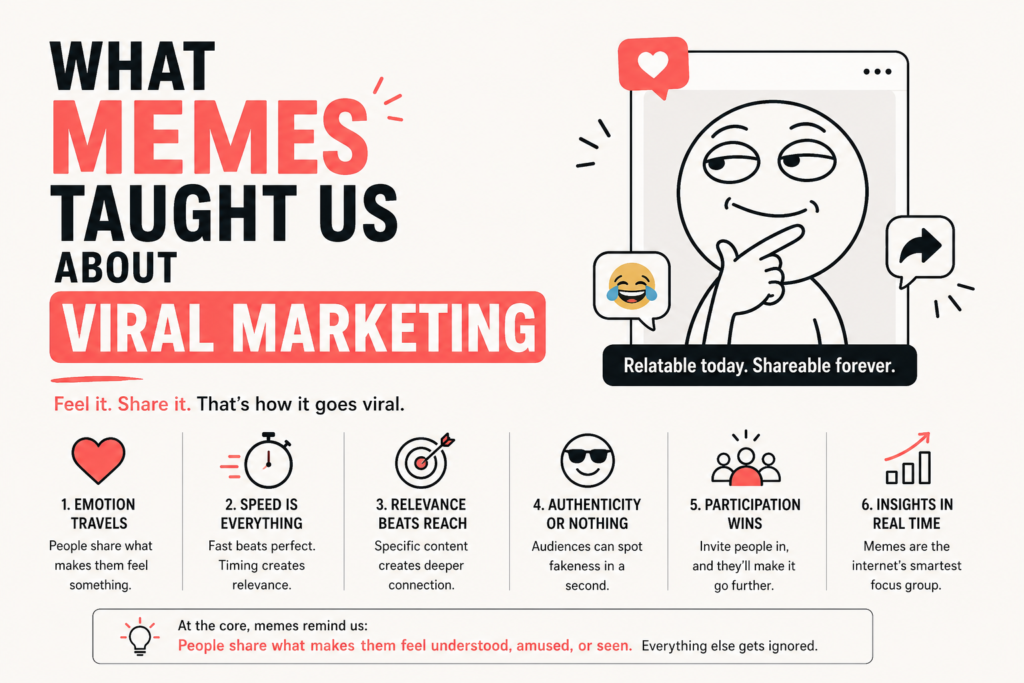
Lesson 1: Emotion Travels. Information Doesn’t.
Marketing school teaches you to lead with features and benefits. Meme culture teaches you that nobody cares until they feel something first.
Think about the most shared memes of any given year. They don’t explain things. They don’t make arguments. They drop you straight into a feeling — overwhelm, pride, Monday dread, irrational happiness about a snack — and you immediately recognize yourself in it.
The marketing takeaway: Before you ask “what do we want people to know?”, ask “what do we want people to feel?” Campaigns built around a genuine emotion — not a manufactured one — are the ones that get shared.
Nike doesn’t tell you their shoes have great grip. They make you feel like a champion who just needs to stop making excuses. Same principle, bigger budget.
Lesson 2: Speed Is Everything. Perfection Is the Enemy.
Memes have a lifespan measured in days, sometimes hours. The entire culture runs on timing. Post a meme two weeks after the moment has passed and you don’t just miss — you look out of touch, which is worse than silence.
Brands notoriously fail here because of approval chains. A social media manager spots a perfect trending moment, writes a great post, sends it up the ladder, waits for legal to sign off, gets three rounds of feedback, and by the time it’s approved, everyone has moved on to the next thing.
The brands that win at meme culture — Wendy’s, Duolingo, Ryanair — have given their social teams real-time creative freedom. They trust junior marketers to post without a committee. That’s terrifying for most companies. It’s also the only way it works.
The marketing takeaway: Build a process that allows for fast creative decisions. If your content approval takes longer than 24 hours, you will always be late to cultural moments. Speed is a competitive advantage.
Lesson 3: Relevance Beats Reach Every Single Time
A meme made for everyone is interesting to no one.
The most powerful memes are weirdly specific. They’re made for a very particular type of person — project managers who over-use spreadsheets, people who grew up with dial-up internet, gym-goers at 6am, people who say “per my last email” through gritted teeth. The specificity is what makes someone go: “Oh my god, this is me.”
Brands are terrified of specificity because it feels like they’re excluding potential customers. But in practice, trying to appeal to everyone produces content so bland that it appeals to no one.
The marketing takeaway: Niche down your content. Know your audience deeply enough to make an inside joke with them. When a segment of your audience thinks “this was made for me,” they share it with everyone who’s like them — and your reach grows organically, without you trying to force it.
Lesson 4: Authenticity Is Detected in Milliseconds
Internet users — especially younger ones — have a finely tuned radar for when a brand is trying too hard. The moment a company uses a meme format slightly wrong, or references a trend six months too late, or adds their logo and a call-to-action to something that was supposed to be spontaneous — the whole thing collapses. It doesn’t just not work. It actively damages the brand.
There’s even a name for it: “fellow kids” marketing, after the infamous 30 Rock bit where Steve Buscemi’s character walks into a school holding a skateboard and says “How do you do, fellow kids?”
The brands that nail meme marketing don’t feel like brands doing memes. They feel like a genuinely funny person who happens to work at a brand. Duolingo’s unhinged green owl. Wendy’s beef with other fast food chains. Ryanair gleefully roasting their own customers. These work because they feel human and slightly unfiltered — not polished and committee-approved.
The marketing takeaway: Authenticity isn’t a strategy you can fake. It comes from giving real humans real creative control and trusting them to represent your brand with personality, not just talking points.
Lesson 5: Participation Beats Broadcasting
Old marketing was a megaphone. You talked, people listened (or ignored you). Meme culture is a conversation. Trends spread because people don’t just consume them — they remix them. They add their own spin, their own caption, their own context. The original creator often has no idea where their meme ends up.
The brands that understand this invite participation instead of just broadcasting. They create formats people can make their own. They respond to comments in ways that generate new content. They hand the mic to their community and let them do the talking.
The marketing takeaway: Design campaigns that invite people to participate, remix, or respond — not just view and scroll past. User-generated content, challenge formats, and open-ended prompts are all meme-adjacent tools that make your audience part of the story.
Where Brands Go Wrong (A Quick Autopsy)
Let’s be honest about the failure patterns:
❌ Forcing a trend that doesn’t fit the brand. A law firm doing the latest TikTok dance. A financial services company using a Gen Z slang term incorrectly. Memes require cultural fluency, and faking it is instantly visible.
❌ Adding a logo and a product link to something that was supposed to feel organic. You can almost hear the marketing meeting: “Can we put our logo in the corner?” No. You cannot.
❌ Treating every trend as a sales opportunity. Memes build brand affinity, not direct conversions. Brands that attach a promo code to every cultural moment miss the point entirely.
❌ Being late. This one cannot be overstated. Internet time moves fast. Three days is an eternity.
The Real Marketing Lesson Memes Are Teaching Us
Strip away the formats and the in-jokes and the trend cycles, and memes are telling us something simple and profound about human behavior:
People share what makes them feel understood, amused, or seen — and they ignore everything else.
That’s not a meme insight. That’s a marketing insight that has always been true, just demonstrated more nakedly and rapidly than anything else we’ve ever seen.
The best digital marketers don’t just study memes for content ideas. They study them because memes are the purest, most honest, most real-time focus group the world has ever accidentally invented.
Every time something goes viral, ask yourself: what feeling did that tap into? Do that enough times and you’ll start to understand your audience better than any survey or demographic report ever could.
Key Takeaways
- Memes go viral because of emotion, not information — build feeling into your content first.
- Speed beats perfection. Slow approval chains kill cultural relevance.
- Specificity creates connection. Niche content reaches more people than generic content.
- Authenticity is instantly detectable — and so is the lack of it.
- Design for participation, not just consumption.
- Treat meme culture as a real-time focus group on human emotion and shareable content.