
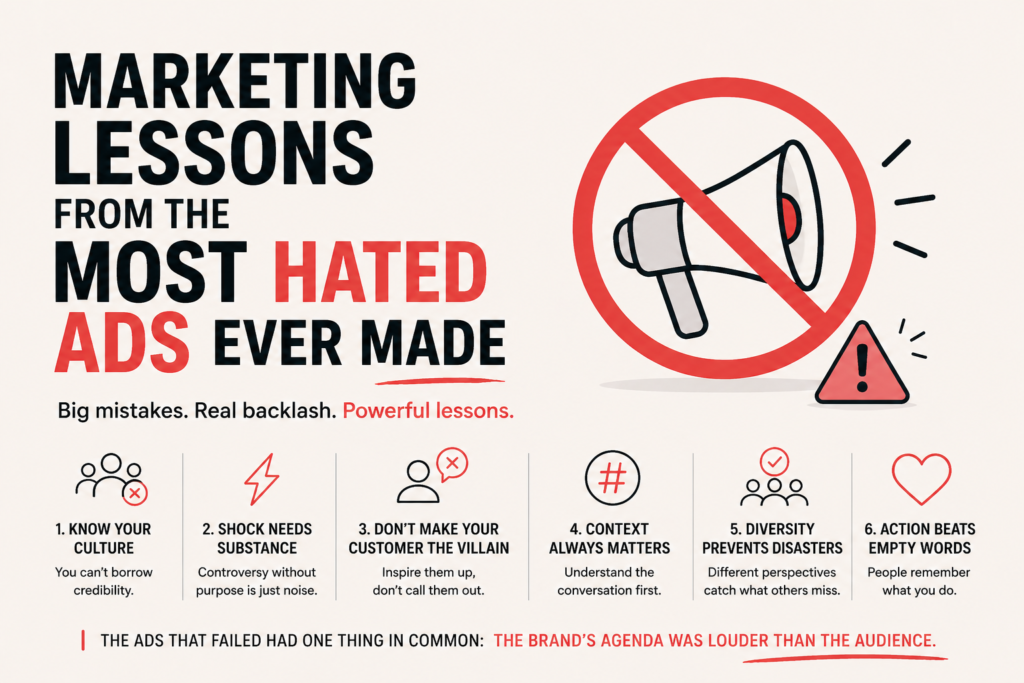
Some ads make you smile. Some make you think. And some make you want to throw your TV out the window. But here’s the uncomfortable truth that most marketers never talk about — the most hated ads in history often taught us more about human psychology, brand strategy, and what NOT to do than any award-winning campaign ever could. Pull up a chair. Class is in session.
Why Terrible Ads Are Worth Studying
Every marketing school teaches the great campaigns. The Apple “1984” Super Bowl ad. Coca-Cola’s “Hilltop.” Nike’s “Just Do It.” These are masterclasses in what right looks like.
But studying only the wins is like becoming a surgeon by only watching successful operations. You learn what works. You never learn where things go catastrophically, publicly, expensively wrong.
The most hated ads in history are crash sites. And crash sites, examined carefully, tell you exactly what forces were in play, what decisions led to disaster, and how to make sure you’re never the pilot of that plane.
So let’s walk through the wreckage. Respectfully. And with a notebook.
Lesson 1: You Cannot Buy Cultural Credibility — Pepsi’s Kendall Jenner Ad (2017)
What Happened
In April 2017, Pepsi released a two-and-a-half minute ad featuring Kendall Jenner walking away from a modelling shoot to join a street protest, before handing a can of Pepsi to a police officer — who smiles, and the crowd cheers.
The internet’s reaction was immediate, unified, and savage.
The ad was accused of trivialising the Black Lives Matter movement. It was seen as reducing genuine civil rights protest — a movement born from real pain and real loss — to a backdrop for a soft drink. Kendall Jenner issued a tearful apology on Keeping Up With the Kardashians. Pepsi pulled the ad within 24 hours and released a statement saying they had “missed the mark.”
“Missed the mark” is one of the great understatements in corporate communications history.
The Marketing Lesson
Purpose-driven marketing is not a costume you put on. You cannot take a cultural movement, strip it of its meaning, resolve it with a product, and expect people to feel good about your brand.
The fundamental error Pepsi made was not in the execution — it was in the premise. They started with “we want to associate Pepsi with unity and social progress” and worked backwards to find a cultural moment to borrow. That backwards process is exactly what audiences can smell from a mile away.
Authentic purpose-driven marketing starts from the inside out — what does this brand genuinely stand for, and how does that connect to the world? Not: what cultural moment can we attach our logo to?
The rule: You can stand alongside a movement. You cannot use a movement as a plot device to sell your product. The moment your brand becomes the resolution of a social conflict, you’ve crossed the line from solidarity to exploitation.
And audiences — particularly younger ones — will hold you accountable with a speed and ferocity that no PR team can outrun.
Lesson 2: Shock Without Substance Is Just Noise — Benetton’s Endless Controversy
What Happened
For decades, the fashion brand United Colors of Benetton made a habit of using deeply shocking imagery in its advertising — a dying AIDS patient surrounded by grieving family, a priest kissing a nun, death row inmates, a blood-soaked war uniform. The campaigns were created by legendary provocateur Oliviero Toscani and consistently generated headlines, protests, boycotts, and debate.
People hated them. Retailers refused to stock the ads. Governments banned them. Religious groups protested outside stores.
But here’s the complicated part: Benetton also became one of the most recognised fashion brands in the world. And their campaigns are still studied in universities today.
So was it a success or a disaster?
The Marketing Lesson
Benetton reveals the most nuanced lesson on this list: controversy without connection is chaos, but controversy with a clear point of view can be a brand-building superpower — if you’re willing to pay the cost.
The reason Benetton’s ads, for all their polarisation, didn’t destroy the brand is because there was a consistent philosophy underneath them. The campaigns weren’t random shock. They were always about human equality, social injustice, and the things polite society preferred not to look at. The brand had a genuine, consistent worldview — and the ads expressed it with extreme boldness.
The lesson is not “be controversial.” The lesson is “be consistent.” Benetton’s ads worked — to the extent they worked — because they were unmistakably, coherently Benetton. You knew what the brand stood for. You might have hated it. But you knew.
The rule: If you’re going to be provocative, have a real reason that connects to your brand’s actual values. Provocation with purpose divides people into passionate supporters and vocal critics — both of whom keep the brand alive in conversation. Provocation without purpose just makes enemies.
Lesson 3: Never, Ever Make Your Customer the Villain — Gillette’s “We Believe” Ad (2019)
What Happened
In January 2019, Gillette released a nearly two-minute ad called “We Believe: The Best Men Can Be” — a direct riff on their iconic tagline “The Best a Man Can Get.” The ad addressed toxic masculinity, showing scenes of bullying, mansplaining, and sexual harassment, before pivoting to images of men intervening, protecting, and doing better.
The reaction split the internet directly in half.
Supporters praised it as brave and necessary. Critics — including a large portion of Gillette’s core customer base — felt lectured to, patronised, and accused of things they hadn’t done. The YouTube video accumulated over a million dislikes within days. A vocal segment of men announced they were switching to competitors. The hashtag #BoycottGillette trended globally.
Procter & Gamble, Gillette’s parent company, later acknowledged an $8 billion write-down in the brand’s value — though this was attributed to multiple factors, not solely the ad.
The Marketing Lesson
There is a critical difference between inspiring your customer to be better and implying that your customer is currently bad.
Gillette’s ad, despite its genuine intent, felt to many viewers like it was opening with an indictment of the very people it was trying to sell razors to. The scenes it showed — bullying, harassment, dismissiveness — were presented as widespread male behaviour before the brand swooped in to suggest a better way.
Compare this to Nike’s approach with “Just Do It.” Nike also inspires people to be better. But Nike starts from a position of belief in the customer — you have what it takes, just do it. Gillette’s ad, to many ears, started from a position of suspicion — you might be part of the problem.
Aspiration and accusation can look similar on paper. In a 30-second ad, the difference is felt immediately and viscerally.
The rule: You can challenge your customer to grow, evolve, or be better. But begin from a place of belief in them, not suspicion of them. The most powerful marketing says “I see greatness in you.” The most damaging says “I see a problem in you.” Even when the intention behind both is identical, the emotional experience couldn’t be more different.
Lesson 4: Tone Deafness Has an Enormous Price Tag — DiGiorno Pizza and the Hashtag Disaster
What Happened
In 2014, the hashtag #WhyIStayed was trending on X (then Twitter). Women were using it to share vulnerable, painful stories about why they had stayed in abusive relationships — a deeply serious conversation sparked by the Ray Rice domestic violence controversy.
DiGiorno Pizza, seeing a trending hashtag, tweeted: “#WhyIStayed You had pizza.”
The backlash was instant and overwhelming. DiGiorno had clearly not read the hashtag before using it. The brand apologised personally to hundreds of people who had shared their abuse stories in the thread — one of the more genuinely remorseful and labour-intensive apologies in social media history. It was, to their credit, handled with sincerity.
But the damage — reputational and human — was done.
The Marketing Lesson
This one is simple and non-negotiable: always, always understand the context of a conversation before inserting your brand into it.
In the age of real-time marketing, the pressure to be fast has never been greater. Trending hashtags look like free traffic. They look like relevance. They look like a shortcut to cultural participation. And sometimes they are.
But they can also be spaces where people are processing grief, trauma, injustice, or pain. And a brand showing up in those spaces with a product joke is not just bad marketing — it’s genuinely harmful.
The DiGiorno incident was not malicious. It was careless. And in marketing, carelessness at scale can cause real damage to real people.
The rule: Before you use any trending topic or hashtag for marketing purposes, spend two minutes understanding what the conversation is actually about. Two minutes of research can save two years of reputation management. Speed is valuable. Mindlessness is dangerous.
Lesson 5: Casting Is a Statement — H&M’s “Coolest Monkey in the Jungle” (2018)
What Happened
In January 2018, H&M published an online product photo showing a young Black child modelling a hoodie with the text “Coolest Monkey in the Jungle” printed on it. The image went viral within hours for deeply painful, obvious reasons.
The backlash was global. The Weeknd, who had a collaboration with H&M, publicly ended the partnership. Several H&M stores in South Africa were damaged in protests. The brand issued an apology and pulled the product.
The Marketing Lesson
Every single image a brand publishes is a statement. Every casting decision, every visual pairing, every choice about who wears what carrying what message — these are not neutral decisions. They communicate something. And in a world where content moves globally in seconds, the responsibility to think carefully before publishing has never been greater.
What makes this case particularly instructive is the obvious question it raises: how did this image pass through an entire production process — photographer, creative director, art director, regional marketing team, global approvals — without a single person flagging it?
The answer, in most post-mortems of incidents like this, is a combination of homogeneous teams and absent perspectives. When the people reviewing content all share the same background, the same cultural reference points, the same blind spots — the blind spots become invisible. Nobody sees what nobody is positioned to see.
The rule: Diversity in your creative team is not a values statement. It is a risk management strategy. A room full of different perspectives catches what a homogeneous room misses — every single time. The creative and reputational cost of getting this wrong vastly exceeds the organisational investment required to get it right.
Lesson 6: Authenticity Cannot Be Faked at Scale — Every Generic “We’re All in This Together” COVID Ad
What Happened
This one isn’t a single ad. It’s an entire genre.
When COVID-19 hit in 2020, brands scrambled to respond. What followed was one of the most remarkable examples of collective marketing failure in history. Dozens of major brands released near-identical ads — piano music, slow-motion footage of empty streets, a voiceover saying some version of “these are uncertain times” and “we’re all in this together” — before cutting to their logo.
A video compilation of these ads — showing how indistinguishably similar they all were — went massively viral. The parodies followed immediately. The backlash wasn’t anger so much as exhausted mockery.
The Marketing Lesson
When every brand says the same thing in the same tone with the same piano music, it stops being communication and starts being wallpaper. The audience doesn’t hear sincerity — they hear a template.
The COVID ad wave is the definitive modern case study in what happens when brands mistake sentiment for substance. Saying “we care” is not the same as showing you care. And when hundreds of brands say “we care” using the same stock footage in the same two-week window, even genuine care becomes indistinguishable from performance.
The brands that stood out during that period weren’t the ones who said the most. They were the ones who did something specific and real — donated products, pivoted manufacturing, waived fees, extended deadlines, supported employees visibly and concretely.
The rule: In moments of genuine collective difficulty, actions speak with a volume that words — especially identical, committee-approved words — can never reach. If you want to show you care, show it. Don’t script it.
The Master Lesson That Runs Through All of Them
Read all six cases and one thread runs through every single one:
The ads that failed most spectacularly were the ones where the brand’s internal agenda was more visible than the audience’s actual experience.
Pepsi needed cultural credibility. Gillette needed moral authority. Dozens of COVID advertisers needed to seem relevant. DiGiorno needed to jump on a trend. H&M needed to sell a hoodie. In every case, the brand’s need was centre stage — and the human beings on the other side of the screen felt it.
The greatest ads ever made feel like they were created entirely for the viewer. The most hated ads ever made feel like they were created entirely for the brand.
That gap — between a brand serving itself and a brand serving its audience — is the gap that every marketer spends their career trying to close.
The hated ads are simply the ones that fell into it, loudly, and in public.
Key Takeaways
- You cannot borrow cultural credibility — purpose-driven marketing must be earned from the inside out, not manufactured from the outside in.
- Controversy with a consistent point of view can build a brand. Controversy without substance just makes enemies.
- Inspire your customer upward — never open with an accusation, even a well-intentioned one.
- Always understand what a trending conversation is actually about before your brand enters it. Two minutes of research can prevent years of damage.
- Diverse creative teams are a risk management strategy, not just a values statement. Homogeneous rooms have homogeneous blind spots.
- In a crisis, action beats scripted sentiment every single time.
- The master failure in every bad ad is the same: the brand’s needs were more visible than the audience’s experience.
Which ad on this list surprised you the most — and which ones do you think actually deserved the hate they got? Let’s debate it in the comments.