
You posted at the “right” time. You used the “right” hashtags. You wrote a caption that took you forty-five minutes. And then — 47 likes, mostly from people who already follow you. Meanwhile someone else posts a blurry photo of their coffee and gets 14,000 impressions. What is going on? The answer is the algorithm. And once you actually understand how it works — not the myths, the actual mechanics — everything changes.
Let’s Kill the Myths First
Before we get into what the algorithm actually does, let’s bury what it doesn’t do — because bad advice about Instagram’s algorithm is absolutely everywhere, and following it is actively hurting your growth.
Myth #1: Posting at the “perfect time” will fix your reach. Time matters. But it’s about the fourth or fifth most important signal. Accounts obsess over whether to post at 7am or 9am while ignoring engagement rate, which matters ten times more.
Myth #2: More hashtags = more reach. Instagram themselves have said that using 3–5 highly relevant hashtags outperforms stuffing 30 generic ones. Hashtag stacking stopped being effective years ago. It now looks like spam to the algorithm.
Myth #3: The algorithm punishes you for editing your caption. This one is completely false and has been confirmed by Instagram multiple times. Edit your caption. Fix your typos. It changes nothing algorithmically.
Myth #4: You need to post every day. Consistency matters. Daily posting does not. An account that posts three times a week with high engagement will always outperform an account that posts daily with low engagement. Quality of interaction beats quantity of output.
Now. Let’s talk about what actually happens.
The Fundamental Truth About the Algorithm
Here is the single most important thing to understand about how Instagram’s algorithm works — the insight that makes everything else make sense:
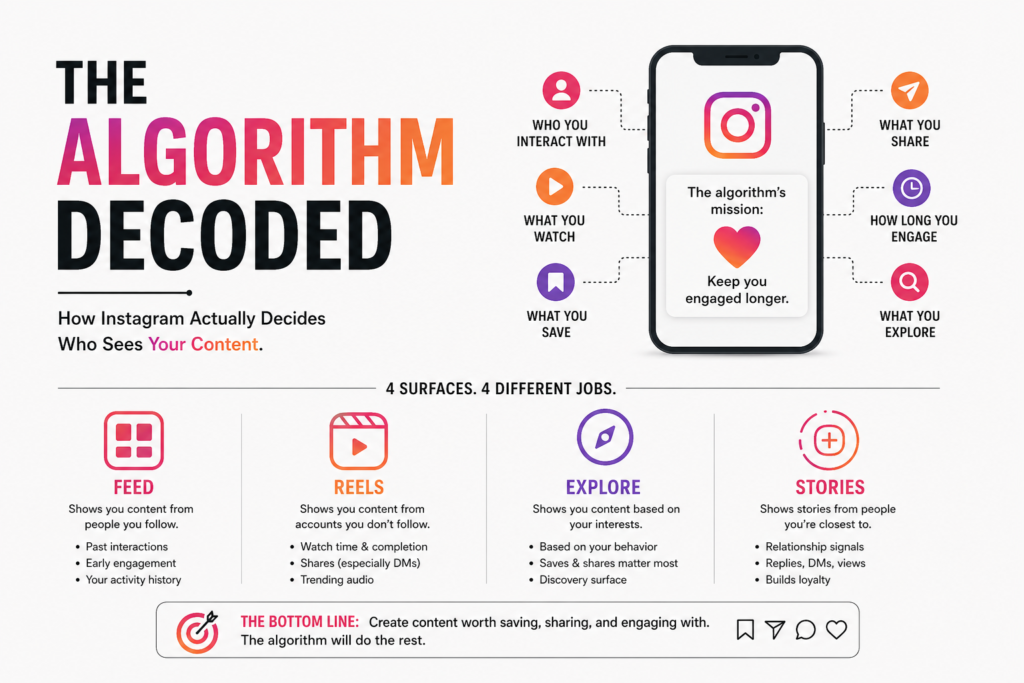
Instagram’s algorithm has one job: keep people on Instagram as long as possible.
That’s it. That’s the whole thing.
Instagram makes money from advertising. Advertising revenue is tied to time spent on the platform. So every decision the algorithm makes — every post it surfaces, every Reel it autoplays, every Story it puts first in your queue — is in service of one goal: maximising the amount of time each user spends scrolling.
This means the algorithm is not trying to reward good content. It is not trying to support small creators. It is not trying to be fair. It is trying to predict, with extraordinary precision, which piece of content will keep a specific user engaged for the longest amount of time.
Once you internalise this, you stop fighting the algorithm and start working with it.
How Instagram Actually Works — The Four Surfaces
Most people talk about “the Instagram algorithm” as if it’s one thing. It’s not. Instagram uses different ranking systems for different parts of the app — and understanding each one changes how you create for each format.
Surface 1: The Feed
Your Home Feed is ranked based on your personal history with each account. Instagram’s own engineering blog has confirmed the key signals, in rough order of importance:
1. Your past interactions with this account. Did you like their last five posts? Did you save one six months ago? Did you reply to their Story? The more you’ve engaged with an account historically, the higher their future posts rank in your feed. This is why consistent content matters — each post is building a relationship that influences the next one’s reach.
2. Post information. How quickly is this post gathering likes, comments, saves, and shares? A post that explodes in the first 30–60 minutes signals to the algorithm that it’s high-quality content worth showing to more people. This is why the first hour after posting is disproportionately important — it’s essentially a performance audition.
3. Account information. How often does this account post? What’s their overall engagement rate? A consistently active account with strong historical engagement gets a baseline boost over dormant or inconsistent accounts.
4. Your activity history. What types of content do you tend to engage with? Carousels? Videos? Long captions? Short ones? Instagram builds a detailed profile of your content preferences and serves you more of what your behaviour says you like.
The Feed Takeaway: To win on Feed, you need strong early engagement and a history of consistent interaction with your followers. The first hour after posting determines whether your post stays small or gets amplified.
Surface 2: Reels
Reels use a significantly different ranking system — and it’s the most aggressive growth surface on the platform right now.
Unlike Feed, which prioritises content from accounts you already follow, Reels is explicitly designed to surface content from accounts you don’t follow. It is Instagram’s answer to TikTok, and its ranking is heavily weighted toward content discovery.
The key signals for Reels are:
Watch time and completion rate. This is the dominant signal — by a significant margin. If people watch your Reel all the way through, or watch it multiple times, the algorithm interprets that as a strong signal of quality and pushes it to more users. A 15-second Reel watched fully outperforms a 60-second Reel abandoned at 10 seconds, every time.
Shares — especially to DMs. When someone sends your Reel to a friend via DM, that is one of the highest-value signals you can generate. It means your content was relevant enough that someone wanted another specific person to see it. The algorithm treats DM shares as a premium engagement signal.
Audio usage. Reels that use trending audio get preferential distribution. Instagram actively pushes content that uses sounds that are gaining momentum — it’s how they compete with TikTok’s audio-discovery culture. Check the Reels audio library regularly and look for the upward arrow on sounds — that indicates trending audio.
The Reels Takeaway: Hook in the first 1–2 seconds (this determines completion rate more than anything else). Use trending audio. Create content people want to send to a specific friend — “send this to someone who…” is one of the most effective Reels formats for algorithmic distribution.
Surface 3: Explore
Explore is the algorithm working in full discovery mode — showing content from accounts you have never interacted with, based purely on predicted interest.
Instagram’s Explore ranking is based on your interaction history across the whole platform — the accounts you’ve engaged with, the hashtags you’ve explored, the types of content you’ve saved — and uses that to build a model of what you’re likely to enjoy from accounts you don’t know yet.
For creators, getting onto Explore requires generating strong engagement signals quickly on a post — specifically saves and shares, which Explore’s algorithm weighs more heavily than likes. A save tells the algorithm that someone found your content valuable enough to return to. It is the highest-quality engagement signal on the platform.
The Explore Takeaway: Design content with saves in mind. Infographics, tips, frameworks, tutorials, and “reference” content — things people save to come back to later — perform disproportionately well on Explore. Ask yourself: “Would someone save this?” If not, think about what would make it worth saving.
Surface 4: Stories
Stories are ranked differently from every other surface — and this one surprises most people.
Stories are shown almost entirely based on the closeness of your relationship with the poster. Instagram calls these “interest signals” — but in practice, Stories are prioritised for accounts you have a genuine, reciprocal, ongoing interaction with.
If someone regularly watches your Stories, replies to them, sends you DMs, or visits your profile directly — their Stories will appear at the front of your queue. If you never interact with an account despite following them, their Stories drift to the back of the line regardless of how good they are.
This makes Stories the most intimate surface on Instagram — and the most powerful for deepening relationships with people who are already engaged with you.
The Stories Takeaway: Stories are not a discovery tool. They are a loyalty tool. Use them to deepen your relationship with existing followers — polls, questions, behind-the-scenes content, direct responses to comments. The engagement they generate feeds back into your overall account health and improves your reach on every other surface.
The Signals That Matter Most — Ranked
Across all surfaces, here are the engagement signals ranked by how much the algorithm values them:
- Saves — The most powerful signal. “I want to come back to this.”
- Shares to DM — High intent. “I want a specific person to see this.”
- Comments — Conversation signals genuine engagement. Longer comments matter more than “🔥” reactions.
- Profile visits from a post — Means the content was interesting enough to make someone want to know more about you.
- Likes — Valuable but the lowest-quality signal. The easiest to give, the least meaningful to the algorithm.
- Time spent — How long someone pauses on your post before scrolling. Even a few extra seconds adds up.
The practical implication: Stop optimising for likes. Start creating content that people save, share privately, or comment on meaningfully. The algorithm is smarter than the like count. You should be too.
What Kills Your Reach — The Signals That Hurt You
The algorithm is not just measuring positive signals. It is also measuring negative ones.
Low watch time on Reels. If people consistently abandon your Reels in the first three seconds, the algorithm interprets this as low-quality content and suppresses distribution. A weak hook is not just a missed opportunity — it is an active penalty.
Posting and going silent. If you post and then log off, you miss the crucial first-hour engagement window. The algorithm rewards accounts that generate — and respond to — fast engagement. Reply to your comments. Respond to DMs. Be present around your post time.
Inconsistent posting. Long gaps in posting teach the algorithm that your account is inactive or unpredictable. You don’t need to post daily, but you need to post with enough regularity that the algorithm keeps you in its active rotation.
Engagement bait. Instagram explicitly penalises posts that use manipulative tactics to drive engagement — “like this if you agree,” “tag two friends to enter,” and similar mechanics. These used to work. Now they actively suppress your reach.
Using irrelevant hashtags. Hashtags tell the algorithm what your content is about. Using generic or unrelated hashtags confuses the categorisation system and reduces your chance of appearing on relevant Explore pages.
The Strategy That Actually Works in 2026
Given everything above, here is what a smart Instagram growth strategy looks like right now:
Create for saves first. Every piece of content should have an answer to “why would someone save this?” If it’s a Reel, maybe it’s a tip they’ll want to reference. If it’s a carousel, maybe it’s a framework they’ll come back to. Saves are the currency the algorithm values most.
Treat the first 60 minutes like a launch. Be available when you post. Reply to every comment. Respond to DM reactions. Share to Stories. The first hour is your amplification window — treat it as the most important 60 minutes in that content’s life.
Use Reels for reach, Stories for depth, Feed for authority. Each surface has a different job. Reels bring new people in. Stories deepen the relationship with existing followers. Feed posts build your overall credibility and archive. Use all three intentionally, not interchangeably.
Make content that people want to send to a specific person. The best question to ask before you post anything is: “Who would send this to whom, and what would they say?” If you can answer that concretely, you’ve probably made something worth sharing.
Build reciprocal relationships, not a broadcast channel. Accounts that engage genuinely with others in their niche — commenting thoughtfully, responding to Stories, participating in conversations — build the interaction history that tells the algorithm this is an active, engaged, valued account. Instagram was built as a social network. The algorithm rewards accounts that actually behave socially.
The Bottom Line
The Instagram algorithm is not your enemy. It is not conspiring against small creators. It is not broken or unfair — at least not in the way most people complain about.
It is a prediction machine. It is trying to guess, for each individual user, what content will hold their attention. Your job as a creator or marketer is to make content that genuinely earns that attention — and to understand the specific signals that tell the algorithm you’ve done it.
Stop chasing hacks. Stop posting thirty hashtags. Stop agonising over 7am versus 9am.
Start asking: is this content interesting enough that someone would save it, share it, or watch it twice? If the answer is yes, the algorithm will find that out — and it will do the distribution work for you.
That’s the deal. Create things genuinely worth people’s time, package them in formats the algorithm can measure, and show up consistently enough to matter.
Everything else is noise.
Key Takeaways
- Instagram has one goal: keep people on the app longer. Every algorithm decision serves that goal.
- There are four separate surfaces — Feed, Reels, Explore, Stories — each with a different ranking system.
- Saves and DM shares are the highest-value signals. Likes are the lowest.
- Reels completion rate is the dominant signal for short-form video distribution.
- The first 60 minutes after posting are your amplification window — be present and engage actively.
- Stories are a loyalty tool, not a discovery tool. Use them to deepen existing relationships.
- Consistent, genuine interaction with your community improves your algorithmic standing across every surface.
Has your reach been declining, growing, or totally unpredictable lately? Tell me what’s working for you in the comments — real data from real accounts beats theory every time.